|
|
|
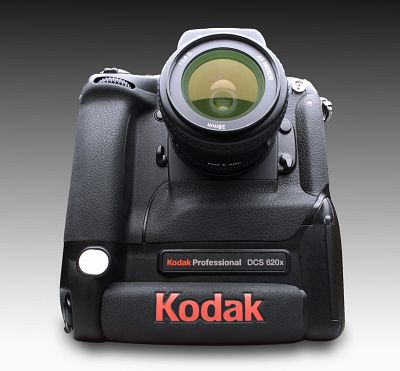
The DCS
620 and DCS
620x As with all
pro-class digital cameras, owning one is either
a major business decision for an essential tool,
or a well thought-out choice for an exciting and
rewarding hobby. (Maybe you could use it for
both?) As a business
decision, you'll share one of the preferred
choices of professional photographers,
photojournalists, industrial, manufacturing, and
aerospace giants, as well as scientific,
military, law enforcement, entertainment,
promotional, and government organizations
worldwide. The quality, durability, and
reliability of the DCS 620 is well-known and
highly respected. As a personal
camera, you'll be able to take photography to
its extreme limits, and enjoy the quality,
speed, and convenience of digital photo
processing at its very finest. Professional
quality sports, wildlife, portrait, family, and
scenic photography are all a natural for the DCS
620. (And remember, it still costs a lot less
than your neighbor's prized Harley Davidson or
60's Mustang, so you really don't need to feel
"too guilty" about spending that much on a
hobby, right?)
Overview - Built on a Nikon
F5 35mm film camera platform, the Kodak DCS 620
is an exceptionally well engineered piece of
equipment... you can count on it. Good (or bad)
pictures will come from the photographer in
"you" - because the camera itself won't let you
down. The camera's
output is consistent, predictable, and reliable.
Left on "automatic", you can expect the same
kinds of results you would get from the
traditional "film" version Nikon F5 35mm camera
in the same mode, while the advanced functions
give the camera the flexibility to capture
outstanding pictures in all kinds of
conditions. The sound
recording feature of the DCS 620 gives the
ability to annotate pictures with verbal notes,
comments, or the surrounding sounds and noises
of the moment. And the huge,
flexible image storage capabilities of the
full-sized PCMCIA memory card slots give
the DCS 620 a strong advantage over film, as
well as competitive digitals with more
restrictive memory storage formats.
Key Features
- Sample
Photos - Click
on the thumbnail pictures below for
full screen viewing
The pictures look great on
the screen, but how do they look in
print? The best part -
pictures from the DCS 620 printed on a top
quality thermal dye sublimation printer are
virtually indistinguishable from top quality
35mm film camera "store processed" prints...
with all of the look, the feel, the depth, and
the durability. I say the "best
part", because it seems like that's the ultimate
benchmark for a digital camera. Show off your
digital prints to anyone, and they'll compare
them (at least in their minds, if not verbally)
to conventional prints. Show someone a picture
on your computer screen, and you're likely to
hear "... that's very nice, but how does it look
when you print it?" And when you pay
this much for a camera, it's really nice to hear
"WOW!!" when people look at your prints. And to
know that even when technology moves upward and
prices fall (inevitably), you've still got
equipment that will put you clearly in the
"front row".
The Removable
Anti-Aliasing Filter - There is a
significant condition that often occurs when
using an anti-aliasing filter in the Kodak DCS
cameras. Many users experience some loss of
image sharpness, especially in low contrast
conditions. Even the best
internal or external sharpening techniques or
onboard camera systems will not completely
restore all of the lost sharpness, although most
is recoverable using PhotoShop (or equivalent)
software sharpening techniques. But in some
cases, acceptable sharpness is not restorable no
matter what you try. Remove the
anti-aliasing filter ? Unfortunately,
traditional lens-mounted hot-mirror filters are
a bit of a "pain". This is because you'll need a
different hot-mirror filter for every different
size lens threads you have (they're rather
expensive - averaging around $100 or more for
the bigger sizes), they're prone to cause lens
flare (big, shiny glass surface), and it's easy
to accidentally get dust trapped in between the
filter and the actual surface of the
lens. An optional
internal Infrared Reduction filter is
available Here's
why the Kodak "removable" factor is so great ...
An internal hot mirror (infrared reduction)
filter kit is now available for the Kodak DCS
520/620/560/660 and Canon D2000 Pro cameras.
Designed as an option to take the place of the
current anti-aliasing / infrared reduction
combination "low pass" filter. Some users (like
myself)) will jump at this option, while some
will stick with the current setup. Part Numbers -
DCS 520 & 560 (and the Canon D2000) take a
catalog number 8407009, the DCS 620 & 660
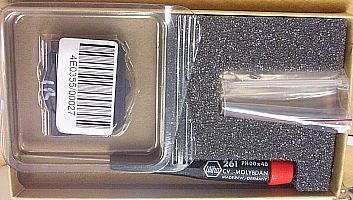
take a catalog number 1185180. The kit will
include the new filter, a special screwdriver
for removal / reinstallation, new screws, and a
case to keep the unused filter in. MSRP ~
$115. Here
it is - Included
in the package - Mounting
screws in a plastic bag. (Lots
of extra screws
included.) And
a nice screwdriver. Removing
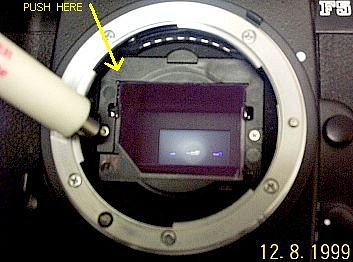
your "old" filter - With
the screws out, push lightly
down in the upper left corner
of the filter with the point
of a small screwdriver (at the
spot shown by the yellow
arrow) - the old filter will
tilt up on the lower right
corner and can be easily
picked up with your thumb
& index finger.
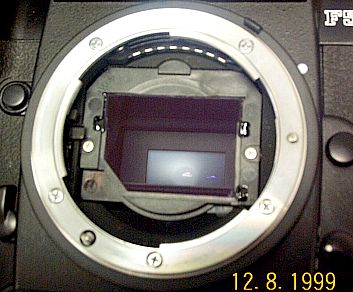
New
filter installed - As
with removal, use a magnetic
screwdriver tip to place the
new screws into the mounting
holes, then slide the magnetic
tip to the side to release the
screws from the draw of the
magnet. The screws will then
seat & tighten easily. As
with the screw removal, the
use of the magnet will prevent
you from dropping the screws
inside the camera.
Need
to shoot at faster shutter speeds or in low
available lighting conditions? Consider
the new DCS 620x digital camera, designed to
push the boundaries of available-light
shooting. This
new version of the DCS 620 digital
camera performs at up to ISO 6400 and
delivers improved image quality with
its innovative high performance
2-megapixel CCD, utilizing a
Cyan-Magenta-Yellow (CMY) Bayer pattern
color filter array. Link
to the Lonestardigital.com DCS 620x
Mini-Review (Includes
sample pictures.) |