|
|
|
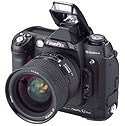
Fuji's
S2 Pro - Everyone agrees that its TTL
flash system works exceptionally well.
Why? It looks like it's because it uses
Nikon's proven film-camera based
"Automatic Balanced Fill-Flash with TTL
Multi Sensor System". By now we're all
familiar with Nikon's "DX" TTL flash system for
its line of digital single lens reflex cameras
(D1, D1H, D1X, D100). Three special Nikon
speedlights (SB-28DX, SB-50DX, and SB-80DX) have
the ability to interface with the camera's
operating system in what Nikon calls the "D-TTL"
mode, where the camera fires a small pre-flash
through the speedlight microseconds before the
actual flash picture is taken. The camera
computes its flash exposure settings based on
the pre-flash exposure analysis. And it works
fairly well... certainly better than a non-DX
flash on its digital SLR lineup. But the DX
series speedlights cost a LOT more than the
standard Nikon speedlights, and there are only 3
model choices. Nikon uses a
similar pre-flash & monitor system on its
better 35mm film cameras called the 3D
Multi-sensor Balanced Fill Flash System. The
camera fires a rapid, almost imperceptible
series of mini flash pulses through the hotshoe
mounted (or built-in popup) speedlight
microseconds before the actual flash picture is
taken, and the camera computes its flash
exposure settings based on the pre-flash
exposure analysis. The big difference between
this system and the digital DX system is that
that it uses regular Nikon speedlights.
The 3D Multi-sensor Balanced Fill Flash System
is a standard feature on the N80, N90S, F5, and
F100 film cameras. But Nikon never
integrated it into their Digital SLR line.
Instead, they came up with the D-TTL system
using special DX speedlights. Why? Who knows...
perhaps the level of engineering sophistication
at the time couldn't make the film-body based 3D
Multi-sensor Balanced Fill Flash System work
properly on the new digital bodies. Fuji
figured out a way to use it on the S2
Pro The N80 camera
body was already equipped with the 3D
Multi-sensor Balanced Fill Flash System, and
Fuji was able to integrate it into its S2 Pro
digital system. It works both with the built-in
popup flash and the full line of standard Nikon
SB series speedlights. With appropriate camera
& speedlight settings, the 3D Multi-sensor
Balanced Fill Flash System works the same way it
does on a Nikon film body. Just like the film
system, the camera fires a rapid, almost
imperceptible series of mini flash pulses
through the hotshoe mounted (or built-in popup)
speedlight microseconds before the actual flash
picture is taken, and the camera computes its
flash exposure settings based on the pre-flash
exposure analysis. The Nikon
D100 is based on the Nikon N80, does it have the
same Automatic Multi-Sensor Balanced Fill-Flash
System? No. The
D100
uses the same DX flash system as the D1, D1H,
and D1X. And even though the DX system works
fairly well on the D100, the opinion on the
street is that the Fuji S2 Pro flash system is
probably better. And again, you can use the less
expensive "regular" line of Nikon speedlights on
the S2 Pro. Flash operation
is covered in detail in the Fujifilm FinePix S2
Pro manual, pages 60-69. It includes a full list
of Nikon SB series speedlights that are
compatible with the S2 Pro's Automatic
Multi-Sensor Balanced Fill-Flash
System
S2 Pro
Sample Picture The reflection
of the setting sun on her sunglasses was by
accident, not by intent... But it certainly made
it a better picture! Straight out of the camera,
the sharpness & overall image quality of a 6
megapixel Jpeg from the Fuji S2 Pro is nothing
short of "amazing". Click
to enlarge: 1200 x 1800 pixels, 798
KB Specifications Type of
camera Interchangeable-Lens
SLR-type digital camera Lens
mount Nikon F
mount (with AF coupling, AF
contacts) Number
of effective pixels 6.17
million pixels CCD
sensor 23.0 x
15.5mm Super CCD Number
of recorded pixels 4,256 x
2,848 pixels (12.1 million) File
format JPEG
(DCF compatible) Storage
media Slot
No.1: SmartMedia (4MB to
128MB/3.3V) Slot
No.2: CompactFlash Type II (Microdrive
compatible) Number
of images (4,256 X 2,848
pixels) Mode 16MB 32MB 64MB 128MB 1GB
Microdrive TIFF-RGB 0 0 1 3 29 CCD-Raw 1 2 5 10 84 JPEG
(FINE) 3 6 13 26 220 JPEG
(NORMAL) 6 13 28 56 469 Usable
lenses D Type
AF Nikkor lenses: All functions
possible View
finder Fixed-eyelevel
pentaprism, built-in diopter adjustment
(-1.8m-1to+0.8m-1) Picture
angle Approx.
1.5x focal length in 35mm[135]
format equivalent Sensitivity Equivalent
to ISO 100, 160, 200, 400, 800,
1600 Shutter Electronically
controlled vertical-travel focal-plane
shutter Shutter
speed 30 to
1/4000 sec, Bulb Shooting
modes Single
frame shooting Continuous
shooting: approx. 2 frames/ sec up to 7
frames Preview
mode Multiple
exposure Exposure
modes P:
Multi-programed AE (Flexible program
possible) S:
Shutter-priority AE A:
Aperture-priority AE M:
Manual White
balance Auto /
Fine / Shade (fine weather) /
Incandescent light / 3 modes for
Fluorescent light / Custom setting
(Custom 1,Custom 2) Metering
range 3D
Matrix Metering: EV 0-21 Exposure
compensation +/- 3
EV range, in 1/2 steps Built-in
flash Guide
No.12 (ISO 100ûm), flash
coverage: 28mm or longer
lens Accessory
shoe Standard
ISO-type with hot-shoe contact (Sync
contact, Ready-light contact, TTL auto
flash contact, Monitor contact, GND),
Safety lock provided Self
timer Electronically
controlled: timer duration: 20sec,
10sec, 5sec, 2 sec LCD
monitor 1.8-inch,
Low-temperature polysilicon TFT
(approx. 117,600 pixels) Playback
function 1
frame Video
output NTSC
(USA/Canada model) Interface USB for
data storage Power
source 4 x AA
type Alkaline or NiMH batteries Dimensions 5.6"(W)
x 5.2"(H) x 3.1"(D) Weight Approx.
27 ounces (without batteries and
lens) |
||||||||||||||||||||||||||||||||||||||||||||||||||||||||||||||||||||||||||||||||||||||||||||||||||||||||||||||||||||||||||||||||||||||||||||||||||||||||||||||||||||||||||||||||||||||||||||||||||||||||||||||||||||||||||||||||||||||||||||||||||||||||||||||||||||||||||||||||||||||

.jpg)